I recently wrote up how my next programming project is going to behave. The program will be called Imager. It’ll be used for scanning old floppy disks and tapes.
First I am going to acquire a PCI Catweasel card so I can write this software for my Mac.
When you first open the software you’ll be presented with a blank window. From the file menu you’ll choose “Read from Catweasel” from a menu and you’ll be presented with a dialog for which tracks and sides you want to read. You’ll confirm the dialog and it will read in the data and present it to you without any post processing. I am talking flux transistions. They will be presented as a wave form for each track/side.
It’s very difficult for a human to understand flux transistions, so you’ll need to add a “signal to block” data converter. You’ll choose a IBM3410/MFM “signal to block” converter. This will collapse the flux transistion pane and insert a new pane below it that shows all of the disk blocks found. The IBM3410 format contains two kinds of blocks: ID blocks and data blocks.
Now add a new WD1779x “Block to Block” converted pane to inturpet the ID and data blocks and combine them into named sectors.
Now you’ll be able to add another “Block to Block” converter. This one will be called “Microsoft DECB allocation unit”. This converter knows how to take sectors and combine them to granules. So you get a list of named granules that you can inspect. It will also alert you if there are incomplete granules since it knows how many sectors are in each granule.
Now for another pane. A “Block to Block” converter called “DECB Files”. This one will know how to read the directory track and granules to find all of the allocated files. It will present you with their name, the ganules they reside on, and the length and any other meta data included on the directory track. You be presented with any error conditions like missing/damaged granules.
That about does it for a DECB disk. But I can further imagine writing format converters for files. If there is a picture on a DECB disk in some obscure format, it’ll be possible to write an image converter so you can see the image in another pane.
Also imagine a cassette tape “signal to block” converter. Imagine being able to decode one track as FM and the other tracks as MFM to get around crude copy-protection implenentations. Imagine a whole stack of OS-9 “Block to Block” converters to verify the contents of those disks. Imagine being able to write your own “Signal to Block” and “Block to Block” converters in a scripting language so you can make the program even more powerful. And finally image every pane being editable, and when edits are made they propagate back up thru the stack all the way to the flux transistion pane. Now you’ll be able to correct errors.
Imagine every pane able to export it’s data so a file can be saved to a native file. Or the sectors can be dumped so the disk image can be used in an emulator.
I have a lot of expectations for this program.
Category Archives: Uncategorized
Copyrights
In 1999 I rejoined the Tandy Color Computer community after an absence of 13 years. I joined every USENET group, mailing list, and message board I could find dedicated to discussing the CoCo. I bought all my hardware and software back from the person I gave it to so many years ago. I even used EBAY to add to my collection. All in an effort to reclaim my youth.
Whenever I joined a new group I would look over the past archives and get a sense of what the people there thought of copyright. Generally there used to be quite a lot consternation regarding the copying of copyrighted material. It seemed it was generally frowned upon.
Personally, I believe copyright (specifically in the U.S., and generally around the world) lasts way too long. I like the idea of tying the length of copyright to the length of a patent. There are powerful commercial pressures to keep patent terms relatively short. Pressures that don’t exist for copyrights. The Copyright Cartel (I’m looking at you, Mickey) is taking advantage of this.
I’m OK with the idea of trademarks lasting (effectively) forever.
I actively engage in civil disobedience with regard to copyright. If a work has been copyrighted longer than the term of a patent, I have no qualms copying the work. I license my own work under various generous terms ranging from GNU GPL to BSD licenses.
The attitudes on the forums I belong to seemed to also have swayed in this direction. People who suggest copying materials are not immediately lambasted.
I should note some exceptions. First of all a vast majority of copyright owners who are able to be contacted gladly give permission for the non commercial distribution of their work. Thus allowing the dissemination of their property on the internet.
A counter example to the above is Lonnie Falk’s The Rainbow. The Rainbow was the most influential Color Computer periodical. It was the most colorful, and lasted the longest. Lonnie stopped publishing The Rainbow in the early 1990s and became mayor of Prospect, Kentucky, the same town where The Rainbow was published. In the late 1990s he set up an internet store to sell back issues of The Rainbow. Wholesale scanning and distribution of this publication was regarded by the community as a bad idea, even to this day.
But there is hope for this publication. A deal was struck with Mr. Falk. to allow the copying of scanned versions of The Rainbow for the price of $0.25 per issue. A very reasonable sum. A small group of volunteers are working on completing the scanning and archiving of this publication. They hope to be finished sometime next year. They plan to charge just a little more than the license fee to cover the costs expended in the endeavor.
So, it turns out even my attitude of copyright is not as unyielding as I first thought.
Alaska and Hawaii
Last Saturday I took the kids to see the movie Cars. We all enjoyed it, but on the drive home my oldest daughter (Bethany) asked there were really small towns like that. Heck I grew up in one. Except it was highway 33 not route 66. So I said there must have been hundreds of places like that.
Then she asked where did route 66 start and finish? After I told her (Chicago to Los Angeles) I said I was partial to Interstate 5. I had to explain it goes from Mexico to Canada, then on into Alaska.
She she said in the most dead-pan voice, you can drive to Alaska? Sure I said, just go thru Canada and you’ll end up in Alaska.
She insisted, you can’t drive to Alaska because it is down by Hawaii. I thought that was a strange thing to say. But then I realized what she meant. I said to her she needs to spend more time in front of a globe, and less time in front of that flat map of the United States.
Apple vs Apple vs Microware
Sometimes Apple Computer really amazes me. In 1980 a small operating system company from Des Moines, Iowa created an operating system called OS-9. It was a good operating system geared specifically for the new 6809 microprocessor. Microware would port their OS to new chips as they came out. 68000, x86, MIPS, whatever.
Then Apple created an operating system called Mac OS 9. Microware sued Apple claiming that they were stealing their trademark. Trademarks are given only for a specific market segment. That is why one company can have a Mac trademark for a computer product, and another company can have a Mac trademark for a cosmetics product.
But Microware had the OS-9 trademark for the computer operating system market segment. This required them to litigate Apple. If they didn’t they might loose their trademark.
It turned out Apple won that lawsuit, Apple convinced a judge that Microware actually had a trademark in the realtime operating system market segment and Apple had a trademark in the desktop operating system market segment. This argument was a bold move by Apple that worked. I was amazed.
Now I learn that Apple has won their trademark lawsuit (and a breach of contract lawsuit) against Apple Corp. The judge said Apple Computer is in the business of selling music and Apple Corp. is in the business of selling the Beatles. Again, I am absolutely amazed.
Mac OS X 10.5
There is a lot of speculation coming out of Robert X. Cringely, including some grounding from John Gruber. I’d like to comment on it.
Cringely says a new kernel is coming for Intel Mac OS 10.5. Gruber says Apple would never release a PowerPC 10.5 with a different kernel than Intel 10.5. But I am not so sure. Gurber admits the kernel of an operating system is hidden from the average user. Developers would have to test against 10.5 wether it had a new kernel or not. But Gruber does have a point, writing operating Systems kernels is hard. Just ask The Hurd.
But what if Apple decided to use the Linux kernel? They could add Mach-o as a first class executable format. They could replace the driver subsystems with IOKit, and bam! You would have a kernel in no time. This would even allow you to run Linux executables (no need to eliminate ELF). Imagine a Gnome or KDE app running side by side to a Mac app. A lot of people find that desirable.
Then Cringely talks about Apple rewriting the Windows XP version of the WIN32 API so they could run Windows applications natively under Mac OS X. Gruber notes how non-trivial this would be and I totally agree it would be to difficult to actually do.
But what if Apple used their cross patent agreement with Microsoft to “Carbonize” the WIN32 API? Pick 80%-95% of the most used calls and rewrite them. This would require Windows Developers to recompile their application, and fix any “missing API” issues. But they will have to do this for Vista anyway. There would be no reason to implement undefined behavior (or bugs).
All Apple would have to do is convince Windows developers to write to 5% of the market.
Father Passes
My father died this morning. He was 120 miles away in a hospital. My mother was with him. The event was wholly expected, so I dealt with this a long time ago.
March?
I tried to make a commitment to post something here at least once a month. I failed for March, this doesn’t count.
Snow Day
Saturday, Feburary 18 was an unexpectedly fun day. My daughters pleaded with me to take them out, and after a few hours of finishing a project on the computer we all decided to go to the park. My wife was still asleep and even she decided to get up and come with us.
So we are driving to the park. A nice one in Pleasant Hill with lots of fun things to do. This is just a city park, nothing all that special. Then I told my wife of my desire to go back to Crissy Field in San Francisco one morning.
It was way to late to do such a trip then, because I really wanted to be in Crissy Field to see the sun rise. But right then my wife had a wonderful idea. She suggest we go up to the top of Mount Diablo. When you live in Diablo Valley the areas largest mountain can be seen from everywhere. It is surprising it took us so long to even think of it. The real reason for going was the recent snow fall. It never snows in the valley, but when it gets cold enough the 3,849 foot high mountain will get a dusting. It usually happens once a year. This was a perfect time to go.
Personally I hate the snow. Too much sunlight reflection and I’ll start to get migraines. But even I was excited to go.
Our trip up the mountain was uneventful. The road was closed about two thirds up the mountain. We hiked up another 200 feet; seeing lots of snow, but most of it was ice and too far off of the road to experience. But it was very fun to be out as a family. On our way down it started to snow. It was then we all agreed to go back the next day for another trip.
The next day my wife was too sleepy to get up and go with us (we left the house at 7:30 A.M.). So this time it was just me and my daughters. The road was closed at the same place as the previous day, so we parked and started to hike again. Sadly, there was less snow on this day. About an hour after we parked we saw a park ranger leading cars further up the mountain. So we quickly went back to our car and drove further up the mountain.
On our drive up we saw more and more snow. We were all getting very excited. The rangers had blocked the road at the top of the mountain. So we parked again and found a true winter wonderland. Real snow (not ice) and lots of it. People sledding down paths. Everyone having a wonderful time. We stayed another hour. Megan kept trying to put snow down my pants (that sure gets old quick).
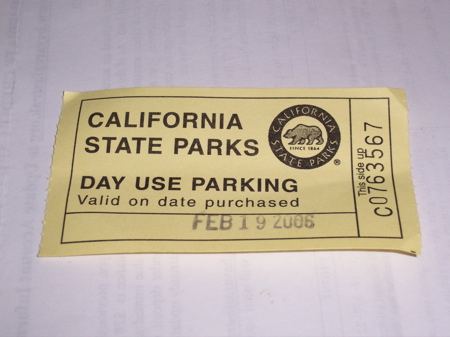
Nine Something
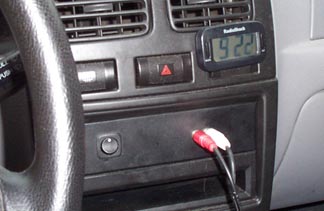
My car came with zero accessories. Not even a clock. I had to go to Radio Shack to purchase a small digital clock so that I would know what time it is when I’m driving around.
I’ve had the car about three years and now the clock batteries are finally wearing down. I can tell because the display is is fading. It’s not as contrasty as it used to be.
But it is also exhibiting a very weird condition. The hour hand is stuck at 9 o’clock. Never mind that this is a digital clock. At 9:59, it rolls over to 9:00. Other than this little problem, it keeps perfect time.
Stephen Colbert
Yesterday I saw Stephen Colbert interviewd live on stage at a City Arts & Lectures event. Oh man did I enjoy it.
The interviewer, the TV critic of the San Francisco Chronicle (I’m too lazy to lookup his name), was excellent in getting Stephen to open up the the audience. But that wasn’t every hard, Stephen has been an actor for a long time. Originally he trained to be a serious stage actor and you really saw it when he jumped out onto the stage and soaked in everyone’s applause.
The most entertaining part of the interview was when Stephen would quickly slip into the Colbert Report character and start answering questions like a pompous know-it-all. But he would just as quickly revert back to regular guy Stephen that we all love.
Before the interview started, the very beginning of the first Colbert Report was shown. This is where truthiness was introduced as the first The Word. He went on to talk about how the AP’s story on the word of the year and how it didn’t mention The Report in an way. He said it was the best thing to every happen because the character needs to be attacked by the liberal media. Complaining about personal attacks is very natural to the character.
We learned about Stephen’s childhood (youngest of eleven children). A tragic moment in his family (His father and oldest brother dying in a plane crash at age ten). His first attempt at college (philosophy major at a small college in South Carolina). His second attempt at college (switching to the drama department at a college in Chicago). They then talked about being a part of Second City, then onto a show with Robert Smigel that I never head of. Then Strangers with candy, a show I never appreciated while it was on. But now I fondly remember it when I think of the characters.
The Daily show is where I first remember him. The Gaydar segment is one of the funniest “Have fun with regular people” segments I’ve ever seen on that show. Of course that was done when Craig Killborne was the host, so it has not been repeated since John Stewart took over. Now that Mr. Colbert has his own show, I don’t know if I’ll ever see it again.
After the interview was over it was time for audience questions. I really wanted to ask about Harvy Birdman but could think of a pithy question.